Upflow Alternative With Upflow Pricing and Upflow Competitors Compared
Upflow is a full accounts receivable platform sold on a quote and a yearly commitment. If what you actually need is the overdue invoices chased this month, DebtAgent drafts and sends an escalating email sequence on each one for a flat $49 a month, with no sales call.
Flat monthly fee from $49. No contingency. You stay the creditor and keep 100% of every payment.
The best Upflow alternative depends on how much of Upflow you would use. Upflow prices every paid plan by yearly invoiced revenue (Starter up to $10M, Grow up to $25M, Scale up to $50M, Accelerate up to $100M), publishes no dollar amount, and asks for a yearly commitment (upflow.io/pricing). DebtAgent publishes its price: $49, $149, $499 or $898 a month, or half that billed yearly, month to month with no notice period. Keep Upflow if you need live NetSuite or Salesforce sync, SMS, calls and letters, cash application and unlimited seats. Choose DebtAgent if the job is getting 30 to 120 day overdue invoices paid without buying a platform first.
Six differences that decide an Upflow purchase
Upflow and DebtAgent both chase your own customers in your own name, and neither takes a cut of what you recover. They are built for different sizes of finance team, and they sell in very different ways.
A quote versus a price
Upflow lists five paid plans and every one says ask for a quote. The plan is chosen by your yearly invoiced revenue, so a company invoicing $8M a year lands on Starter whatever its overdue balance. DebtAgent shows the dollar amount on the pricing page and you can pay for it today.
Yearly commitment versus month to month
Upflow states that each plan includes a yearly commitment, prepaid, with usage billed after. DebtAgent bills monthly or yearly, and you cancel from the billing portal with no notice period and no cancellation fee.
Platform versus the chasing job
Upflow covers reminders, a branded customer portal, payments, cash application, analytics, AI agents and two-way CRM sync. DebtAgent does one part of that very well: it writes and sends the follow up on overdue invoices, from friendly to firm to final.
Live sync versus your aging report
Upflow connects natively to QuickBooks Online, Xero, NetSuite, Sage Intacct and more. DebtAgent loads open invoices from a pasted list or a CSV export of your aging report, so it runs beside any billing system without an integration project.
Channels
Upflow sends email, SMS, calls and letters, with SMS, calls and letters billed as usage. DebtAgent sends email sequences only, each message drafted from the real amount, invoice number and due date, and approved by you before it goes out.
What the debtor sees
Upflow gives customers a branded portal from the Grow plan. Every DebtAgent debtor gets a private page with the open balance where they can pay, promise a payment date, raise a dispute or ask you to stop contacting them, and the cadence reacts to each choice.
How to decide between Upflow and DebtAgent in one week
Run the test on your own numbers before anyone books a demo. Most teams know the answer by Wednesday.
-
Step 1
Day 1. split the aging report
Export open receivables from QuickBooks, Xero, NetSuite or your billing system. Write down dollars 1 to 30 days past due and dollars more than 30 days past due. The second figure is what a collections tool has to move.
-
Step 2
Day 2. count what you would really use
List the Upflow features you need in the first year. If the list is reminders and a payment link, you are buying a platform to do the job of a sequence. If it includes cash application, multi-entity and Salesforce sync, Upflow is the right shape.
-
Step 3
Run the ten oldest invoices on days 3 and 4
Load the ten oldest overdue invoices into DebtAgent and generate a full sequence for each. Read every message as the customer would. If you would send it yourself, approve it and let the cadence run.
-
Step 4
Day 5. price the first year
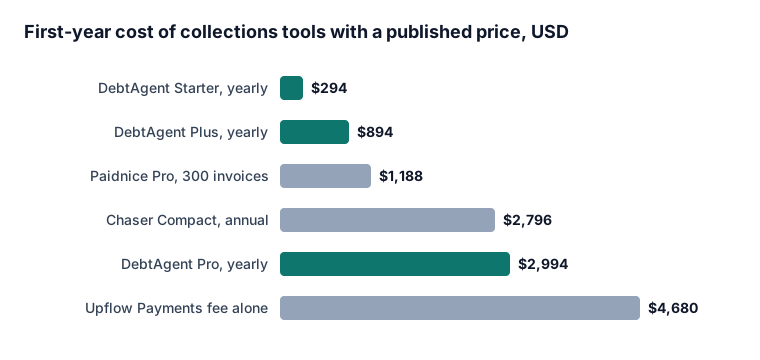
Ask Upflow for a written quote including the yearly commitment, onboarding, SMS and letter usage and the $390 a month Payments fee if you want card and ACH. Put it next to $294, $894 or $2,994 for a year of DebtAgent and next to the dollars sitting past 30 days.
Upflow vs DebtAgent pricing and features compared
Upflow figures come from upflow.io/pricing, read in October 2026. We kept every row where Upflow wins, and there are several.
| Feature | DebtAgent | Upflow |
|---|---|---|
| Published price | $49, $149, $499 or $898 a month | None. Every paid plan is ask for a quote |
| What sets the plan | Active debtors and sequences per month | Yearly invoiced revenue (GIV): $10M, $25M, $50M, $100M, over $100M |
| Commitment | Month to month, or yearly at 50% off | Yearly commitment on each plan, prepaid |
| Cancel | Billing portal, no notice period | Per contract |
| Users | No seat pricing, team roles included | Unlimited seats on every plan |
| Accounting integration | CSV or pasted aging report | Live: QuickBooks Online, Xero, NetSuite, Sage Intacct and more |
| CRM sync | No | HubSpot from Scale, Salesforce from Accelerate |
| Channels | Email only | Email, SMS, calls and letters (usage billed) |
| Card and ACH payments | Debtor page links to your own payment method | Upflow Payments, $390 a month plus 3.5% + $0.30 card, 0.8% ACH capped at $5 |
| Cash application | No | Cash Application Agent from Accelerate |
| Escalating tone on overdue accounts | Friendly, firm and final stages set by days overdue | Reminder workflows you configure |
| Compliance audit log | Every touch, allowed or blocked, timestamped | Not listed on the pricing page |
| Try before you buy | 10 sequences after email confirmation, no card | Free Discover dashboard, paid plans by quote |
| Share of recoveries | You keep 100% | You keep 100% |
| Best for | Teams under about $10M invoicing who need the overdue tail chased now | Finance teams that want one platform for the whole receivables process |
Upflow does not publish what a plan costs in dollars, so no row here guesses one. Ask for the yearly figure in writing, including usage fees for SMS, calls and letters.
What does Upflow do?
Upflow is accounts receivable automation software for B2B companies. It connects to your accounting system, reads open invoices, and runs reminder workflows by email, SMS, phone call and letter. Above that it adds a branded portal where customers can see and pay invoices, Upflow Payments for card and ACH, collection analytics, a Gmail and Outlook inbox integration, a REST API, multi-entity dashboards and, on the higher plans, AI agents for collections, AP portal uploads and cash application. Unlimited user seats come with every plan.
That is a lot of product, and for a finance team running receivables across several entities it is the right amount. The question for a smaller team is how much of it the first year would use. If the honest answer is reminders on the invoices that are already late, you can buy that job on its own.
How much does Upflow cost?
Upflow does not publish a dollar price for any paid plan. As read on upflow.io/pricing in October 2026, the plan you get is set by your yearly gross invoiced value:
- Starter: up to $10M a year invoiced, 40,000 new invoices a year, one entity.
- Grow: up to $25M, 100,000 invoices, two entities, adds the branded customer portal, Slack, the API and NetSuite and Sage Intacct.
- Scale: up to $50M, 200,000 invoices, adds the Smart Rules engine, HubSpot sync and the Collections Agent.
- Accelerate: up to $100M, 300,000 invoices, adds Salesforce sync, Enterprise SSO and the Cash Application Agent.
- Enterprise: over $100M, 700,000 invoices.
The page states that plans are prepaid, that each plan includes a yearly commitment, and that SMS, calls and letters are billed as usage at rates it does not list. If you want customers to pay by card or ACH inside Upflow, Upflow Payments adds a $390 a month platform fee on every plan, plus 3.5% + $0.30 per card payment and 0.8% per ACH debit capped at $5. That platform fee alone is $4,680 a year before the subscription.
Who are Upflow's competitors?
Upflow competes with three groups of tools, and they price very differently.
Enterprise AR platforms: HighRadius, Billtrust, Versapay, Tesorio, Esker and Quadient AR. None of them publishes a price; Tesorio's pricing page offers a demo and an ROI calculator only. These are the right comparison if you invoice well over $50M a year.
Mid-market chasing tools with a list price: Chaser (Compact $259 a month or $233 billed yearly with 4 users, Core $779, Complete $1,169, chaserhq.com/pricing), Paidnice (Essentials $69 for 150 invoices a month, Pro $99 to $799 by invoice volume, paidnice.com/pricing) and InvoiceSherpa ($49, $99 or $199 a month plus a 1% fee on invoices paid through it, invoicesherpa.com/pricing). Our Chaser alternative comparison and Paidnice alternative comparison work through each one.
Collections-first tools: DebtAgent sits here. It does not try to replace your accounting system or your payment stack. It runs the follow up on overdue accounts and records every touch, which is the part of receivables most small finance teams fall behind on.
Upflow vs other invoice collection platforms, which one actually works best for cutting DSO?
The platform that cuts DSO fastest is the one your team actually turns on this month. Days sales outstanding falls when overdue invoices get a timely, specific follow up and the customer has an easy way to pay. Upflow does both inside a full receivables platform; DebtAgent does the follow up and gives every debtor a payment page, without an integration project or a yearly contract.
In practice DSO is driven by the 31 to 90 day bucket. Invoices that get a second and third touch inside that window are recovered at far higher rates than invoices that sit until someone has time; once an account is past 180 days, recovery often drops below 15%. So the useful test is not a feature list. It is how many of last quarter's late invoices received three follow ups before day 60. If the answer is few, the cheapest tool that sends those follow ups on schedule will move DSO more than the most complete platform still in procurement. Our page on accounts receivable automation shows how the cadence is timed.
When Upflow is the better choice
We would point a buyer to Upflow, not to us, in four situations. First, when you need a live two-way sync with NetSuite, Sage Intacct, HubSpot or Salesforce so payments and notes write back automatically. Second, when you want SMS, phone calls and physical letters run from the same tool. Third, when cash application is a daily job and an agent matching remittances would save hours. Fourth, when several entities report into one dashboard and an auditor wants one system of record for receivables.
If two or more of those apply, take the Upflow quote seriously and get the yearly commitment, onboarding and usage rates in writing. If none of them apply, you would be paying for a platform to do the work of a sequence.
What switching to DebtAgent looks like
There is no migration. Export your open receivables to CSV or paste the list, and each debtor appears with the amount, invoice number, due date and days overdue. Pick the oldest ten, generate a sequence for each, read the drafts and approve them. Messages go out from your company name with replies to your own inbox, and the cadence stops itself when you mark an invoice paid or the debtor promises a date on their page.
Plans are counted by active debtors and sequences, not by invoiced revenue: Starter covers 50 active debtors and 100 sequences a month, Plus 250 debtors and 500 sequences, Pro unlimited debtors and 1,000 sequences. Yearly billing costs half, so Starter is $294 for the year. If you also want a broader view of which tools fit a subscription business, read our roundup of the best collections software for SaaS companies.
Upflow alternative questions
What is the best alternative to Upflow?
For a small or midsize US finance team that needs overdue invoices chased without a yearly contract, DebtAgent is a strong Upflow alternative at $49 to $499 a month, published and month to month. For a team that needs live ERP sync and multichannel outreach with a list price, Chaser starts at $259 a month. Enterprise teams usually compare Upflow with HighRadius, Billtrust or Versapay.
How much does Upflow cost per month?
Upflow does not publish a monthly price. Its pricing page sets the plan by yearly invoiced revenue, from Starter up to $10M to Enterprise over $100M, and every paid plan says ask for a quote. Plans carry a yearly commitment. Upflow Payments, if you add it, is a published $390 a month platform fee plus card and ACH fees.
Does Upflow have a free plan?
Upflow offers a free Discover tier that gives access to a dashboard, insights and benchmarking. Reminders, workflows and the collection features sit in the paid plans, which are quoted. DebtAgent offers a one-time trial of 10 collection sequences after you confirm your email, then a paid plan from $49 a month.
Does Upflow integrate with QuickBooks?
Yes. Upflow lists native integrations with QuickBooks Online and Xero from its Starter plan, and NetSuite and Sage Intacct from Grow. DebtAgent does not sync with QuickBooks; it works from a CSV export or pasted list of your open invoices, which also lets it run beside QuickBooks Desktop or any billing system.
Is Upflow good for small businesses?
Upflow is built to scale with a finance team, and its entry plan covers companies invoicing up to $10M a year with unlimited seats. A very small business may find a quote-based yearly contract heavy for what it needs. If the need is chasing a few dozen overdue invoices, a month to month tool with a published price is usually the simpler purchase.
Can DebtAgent send SMS or make calls like Upflow?
No. DebtAgent sends email sequences only. Each message is drafted from the invoice details, escalates from friendly to firm to final, and is approved by you before it is sent. If SMS, calls and letters from one tool are a requirement, Upflow or Chaser fits that requirement better.
Does either tool take a percentage of what is collected?
No. Upflow and DebtAgent are both subscription software, so you keep 100% of every payment. That is the main difference from a collection agency, which commonly keeps 20% to 35% of what it recovers on B2B accounts and up to 50% on small or old claims.
You are handing us your customers' names. Here is what happens to them.
Collections data is unusually sensitive, so we treat it that way: TLS in transit, encrypted storage, a full compliance audit log, and debtor records that are never used to train public models. Card details go to our payment processor and never touch us. Account deletion means delete, everywhere. We are also honest about where we are not yet: no SOC 2 report yet, no SSO yet, no invented customer logos or testimonials either.
Chase the late invoices this week, decide on a platform later
Load one real overdue invoice and the agent drafts the full friendly, firm and final sequence in your company's name. Approve it and the cadence runs until the invoice is paid.
-
comparison Chaser alternative Chaser's published plans and Care bundles against a $49 flat fee.
-
pricing Tesorio pricing What Tesorio contracts cost per year and what moves the quote.
-
comparison Gaviti alternative Gaviti's quote-only AR suite against a published $49 plan.
-
comparison Paidnice alternative Invoice-volume pricing on QuickBooks and Xero compared with debtor pricing.
-
AI for AR AI accounts receivable agent What an AI agent does on the overdue ledger, priced for small teams.
-
pricing Debt collection software pricing Seventeen collections tools compared on what they publish.
-
roundup Best collections software for SaaS companies Priced options for subscription businesses that bill by invoice.
-
how it works Accounts receivable automation How the follow up cadence is timed from days overdue.
-
xero accounts receivable Xero accounts receivable automation with reminders that keep going after Xero stops
-
Bill.com alternative Bill.com Alternative Compared on Pricing, Accounts Receivable Features and Per-User Cost
-
CollBox alternative CollBox Alternative and CollBox Pricing Compared With Flat-Fee Collections for Law Firms
-
Rocket Receivables alternative Rocket Receivables Alternative Compared on Pricing, Stage One vs Stage Two and Flat Fee Collections
-
best accounts receivable software for small business Best accounts receivable software for small business with prices compared
-
best collections software for law firms Best collections software for law firms compared on published price (6 options)