Best Collections Software for SaaS Companies Billing by Invoice
Failed card renewals and unpaid annual invoices are two different problems. Nine collections tools SaaS finance teams shortlist, compared on published price and on which problem each one solves.
Draft a compliant collection sequence for a real overdue amount. No card, no signup to preview.
The best collections software for a SaaS company depends on which money is late. Failed card renewals are a billing problem, and the dunning built into Stripe Billing, Chargebee or Maxio handles them. Annual and quarterly contracts invoiced on net 30 or net 60 are a receivables problem, and they need a tool that chases each overdue invoice with an escalating follow up. For that second job, DebtAgent runs the sequence in your company's name for a flat $49 to $499 a month, published and month to month. Chaser starts at $259 a month, Paidnice at $69, and Upflow, Chargebee Receivables and Tesorio sell on a quote.
Every price below was read on the vendor's own pricing page in October 2026. Where a vendor publishes no price, we say so rather than repeat a figure from a listicle. DebtAgent is our product, so the table shows where each competitor is the better buy.
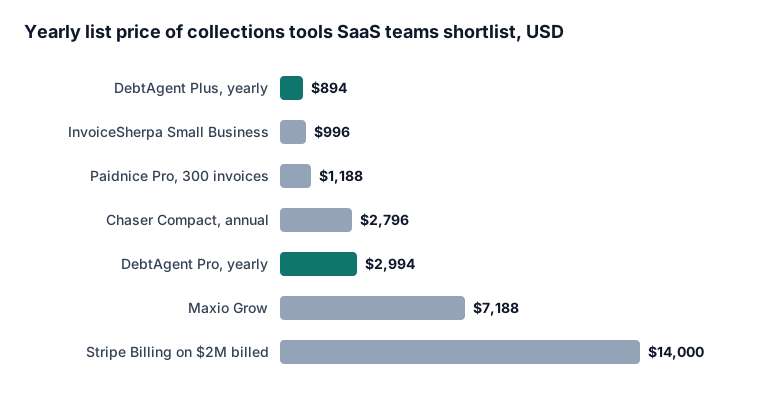
Collections software for SaaS companies compared on published price
| Tool | Published price | Best at | Watch for |
|---|---|---|---|
| DebtAgent | $49, $149, $499 or $898 a month; yearly billing costs half ($294, $894, $2,994, $5,388) | Escalating follow up on overdue invoices, approved by you, with a timestamped log | Email only; works from a CSV or pasted list, no live billing sync |
| Stripe Billing | 0.7% of billing volume, pay as you go | Smart Retries on failed cards, automatic reminder emails, up to three recovery automations | Reminders are templated; no escalating collections cadence for large invoices |
| Chargebee Receivables | No published price; sold as a separate product | AI collections tied to Chargebee subscriptions; smart dunning is included in Chargebee Billing | Only makes sense if you already bill on Chargebee |
| Maxio | Grow $599 a month up to $100k monthly billings; Scale by quote | Billing, revenue recognition and SaaS metrics in one place, with A/R management | A/R management is listed among optional modules with no price |
| Upflow | No published price; plans set by yearly invoiced revenue, yearly commitment; Payments adds $390 a month | Full AR platform with portal, payments, CRM sync and AI agents, unlimited seats | Quote and contract before you start |
| Chaser | Compact $259 a month ($233 billed yearly) with 4 users; Core $779; Complete $1,169 | Mid-market reminder workflows, multi-entity from Core, optional done-for-you Care | Care is sold only in bundles from $1,199 a month |
| Paidnice | Essentials $69 for 150 invoices a month; Pro $99 to $799 by volume | Reminders, late fees and a payment portal on Stripe, QuickBooks Online or Xero | Price climbs with invoices per month; SMS $0.10 each |
| InvoiceSherpa | $49, $99 or $199 a month ($41, $83, $166 yearly) plus 1% of invoices paid | Simple reminders for QuickBooks Online and Xero users | The 1% fee is waived only for payments processed through Propelr |
| Tesorio | No published price; demo and ROI calculator only | Cash forecasting with collections for larger finance teams | Enterprise sales cycle |
What is the best collections automation software for B2B SaaS?
For a B2B SaaS company under roughly $10M in annual billings with invoiced annual contracts, the best collections automation software is one you can switch on this week at a known price. DebtAgent and Paidnice publish prices and need no implementation; Chaser publishes prices with a heavier setup; Upflow, Chargebee Receivables and Tesorio fit larger teams that can run a procurement process.
The split that matters is between subscription billing and contract invoicing. A self-serve product charging cards monthly loses most of its late revenue to declined payments, and a billing system's retries recover a large share of those automatically. A sales-led product invoicing $18,000 a year on net 30 has a different problem. The invoice went to an accounts payable inbox, nobody replied, and the renewal call is in four months. That account needs a person, or a tool acting like one, to send a specific, escalating follow up. If failed renewals are the bigger leak, dedicated failed payment recovery software is the better first purchase; this article is about the invoiced side.
Why billing system dunning is not enough for invoiced contracts
Dunning in Stripe Billing, Chargebee and Maxio was designed around a card on file. When the card fails, the system retries and emails a link to update it. On an invoiced contract there is often no card at all. The customer pays by ACH or check after their own approval process, so a retry does nothing and a templated "your payment is overdue" email lands in the same shared inbox as the first one.
What gets an invoice paid at that point is specific information delivered on a schedule: the invoice number, the amount, the original due date, who signed the order, and what happens next if it stays unpaid. A cadence that moves from friendly at day 3 to firm at day 21 to final at day 45 works because each message reads differently from the last. That is the work a collections tool does and a billing system mostly does not. We explain the timing in more detail on our dunning software page.
Which collections automation software doesn't require a dedicated IT team to implement?
Collections software that works from a CSV export of open invoices needs no IT team at all. DebtAgent loads your aging report from a file or a pasted list, so a controller can run the first sequence the same afternoon. Paidnice and InvoiceSherpa connect to QuickBooks Online, Xero or Stripe in a few clicks. Upflow, Chargebee Receivables, Maxio and Tesorio usually involve an onboarding project.
The trade off is real. A live sync writes payments back and keeps the open balance current without anyone exporting a file. A CSV workflow means someone marks invoices paid, or re-uploads the aging report each week. For a team chasing 20 to 200 overdue accounts that is a few minutes a week. For a team chasing 5,000 it is not, and a synced platform earns its price.
How each tool fits a SaaS finance team
DebtAgent, for the overdue invoices on annual and quarterly contracts
DebtAgent drafts a friendly, firm and final email sequence for each overdue invoice from the real amount, invoice number and due date, and sends nothing until you approve it. Messages go out under your company name with replies to your own inbox. Each debtor gets a private page showing the open balance, where they can pay through your existing payment link, promise a date, dispute the invoice or ask you to stop contacting them, and the cadence reacts to that choice. Plans count active debtors, not seats or billing volume: 50 on Starter, 250 on Plus, unlimited on Pro. You can try 10 sequences after confirming your email, without a card. See how it works on the AI accounts receivable agent page.
Stripe Billing, for card failures you already pay for
If you bill through Stripe Billing, you already have Smart Retries, automatic emails on failed or late payments, and up to three recovery automations, inside the 0.7% of billing volume you pay. Turn them on and tune the retry schedule before you buy anything else. They will not chase a $24,000 invoice that a customer's AP team has parked.
Chargebee Receivables and Maxio, if you already bill on them
Both sell collections as part of a billing and revenue platform. Chargebee lists Receivables as a separate product with no price on its page; Maxio lists A/R management among its modules, with the Grow plan at $599 a month for companies billing up to $100k a month. The advantage is one system of record. The cost is a quote and usually an annual agreement.
Upflow, Chaser and Paidnice, the dedicated AR tools
Upflow is the most complete of the three, with a portal, payments, CRM sync and AI agents, priced by yearly invoiced revenue through a quote; our Upflow alternative comparison lays out its plans and the $390 a month Payments fee. Chaser publishes prices starting at $259 a month for four users. Paidnice starts at $69 and lists Stripe beside QuickBooks Online and Xero among its integrations, which makes it a natural fit for a Stripe-billed SaaS that wants reminders and late fees on invoices.
Which AR automation platform is best for segmenting collections outreach by customer risk and account value?
Upflow's Smart Rules engine from the Scale plan and Chaser's workflows on Core and above both let you route customers into different cadences by attributes such as balance or segment. Tesorio and other enterprise platforms add risk scoring. DebtAgent segments more simply: you choose the cadence and tone per debtor, and the stage is set by days overdue, which covers most teams with fewer than a few hundred late accounts.
How to choose in one week
Start with last quarter's numbers. Split late revenue into failed card payments and unpaid invoices. If failed cards are most of it, fix retries and card updating first. If unpaid invoices are most of it, count how many overdue accounts you have and how many people will touch the tool.
Under about 250 overdue debtors and one or two people in finance, a published-price tool you can cancel monthly is the low-risk choice; run your ten oldest invoices through it and judge the drafts. Above that, or with several entities and a CRM that sales lives in, request quotes from Upflow and Chaser and ask for the yearly total in writing, including usage fees and payments add-ons. If your enterprise customers sit on net 60 and keep paying at day 90, our guide to the best collections automation software for net 60 customers covers that specific pattern, and the full price list for the category is on our debt collection software pricing page.
Whatever you pick, none of these tools takes a share of what you collect. A collection agency would keep 20% to 35% of every recovered B2B dollar, so on a $30,000 overdue balance even the most expensive subscription here is cheaper if it gets the customer to pay.
Frequently asked questions
What is the best collections software for SaaS companies?
For invoiced SaaS contracts, DebtAgent is a strong choice at a published $49 to $499 a month with no implementation. Paidnice suits Stripe-billed teams wanting reminders and late fees from $69. Chaser starts at $259 for four users. Upflow, Chargebee Receivables and Tesorio fit larger finance teams and are priced by quote.
Is Stripe Billing enough for SaaS collections?
Stripe Billing is enough for card failures: Smart Retries and automatic emails recover many declined renewals within the 0.7% of billing volume it charges. It is not built to chase large invoices paid by ACH or check after an approval process. Those need an escalating, specific follow up from a collections tool.
How much does collections software cost for a SaaS company?
Published prices run from $49 a month for DebtAgent Starter and InvoiceSherpa to $69 for Paidnice Essentials, $259 for Chaser Compact and $599 for Maxio Grow. Upflow, Chargebee Receivables and Tesorio do not publish a price. Yearly billing lowers most of these, and DebtAgent's yearly plans cost half.
What is the difference between dunning and collections for SaaS?
Dunning recovers failed automatic payments by retrying the card and asking the customer to update it. Collections chases invoices the customer has not paid, usually on net terms, with follow ups that escalate over weeks. A self-serve SaaS mostly needs dunning; a sales-led SaaS invoicing annual contracts needs collections.
Can I use collections software without changing my billing system?
Yes. DebtAgent works from a CSV export or pasted list of open invoices, so it runs beside Stripe, Chargebee, Maxio, QuickBooks or any other billing system. Paidnice and InvoiceSherpa connect to existing accounting or billing tools. Chargebee Receivables only makes sense if you bill on Chargebee.
- More on can you send an unpaid invoice to collections: You can send any past-due invoice to collections whenever you choose. What matters is the timing, the paperwork, and whether an in-house reminder would have worked first.
- More on best collections automation software for net 60 customers: Seven collections automation tools priced on the same list of 40 net 60 customers, with the escalation timeline and the three signals that flag an account long before it hits 90 days overdue.
- Related page: Accounts Receivable Outsourcing
- Related page: Accounts Receivable Automation