Tesorio Pricing and What a Tesorio Contract Costs per Year
Tesorio publishes no price. Here is what buyers actually pay per year, what pushes a quote up, and which collections tools publish a price you can compare.
Draft a compliant collection sequence for a real overdue amount. No card, no signup to preview.
Tesorio pricing is not published. Tesorio's pricing page offers a demo and an ROI calculator, and every contract is quoted. Buyer data gives the range: Vendr reports a median Tesorio contract of $17,644 a year, with deals from about $7,500 to $43,591, on 12-month terms usually invoiced annually upfront. ERP Research puts larger deployments at $25,000 to more than $200,000 a year. If your team needs the overdue invoices chased rather than a full receivables platform, DebtAgent publishes its price at $49 to $898 a month, or half that billed yearly, and you can cancel any month.
Every Tesorio figure below comes from Tesorio's own site or from a named buyer-data source, read in October 2026. Where sources disagree, we show both. DebtAgent is our product, so this page also says plainly when Tesorio is the better buy.
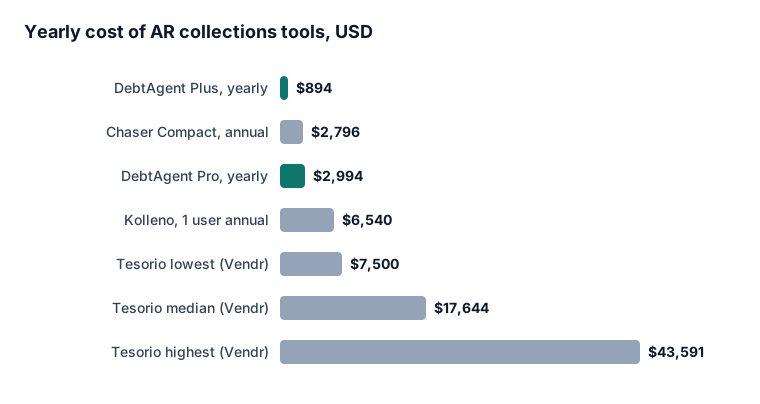
How much does Tesorio cost per year?
Most Tesorio contracts land between $7,500 and $45,000 a year, with the middle around $17,600. That is the picture from Vendr's buyer data, which is the only source built on actual signed deals. Larger multi-entity rollouts can run far higher, and the quote depends on how many invoices you process, which modules you switch on and which systems Tesorio has to connect to.
| Source | What it reports | How to read it |
|---|---|---|
| tesorio.com/pricing | No plans or prices. Contact sales and an ROI calculator | Every deal is quoted |
| Vendr buyer data | Median $17,644 a year, chart range about $7,500 to $43,591, 12-month standard term, annual invoicing upfront | Closest thing to a real price; based on deals Vendr handled |
| Vendr page text | Says most organizations pay $30,000 to $150,000 a year | Contradicts its own chart, so treat it as an upper band |
| ERP Research | $25,000 to $200,000+ a year by deployment scope, annual subscription, quote based, no free trial | Wide estimate, useful for enterprise scope |
| TrustRadius | No pricing plans listed, no free version or trial | Confirms there is no self-serve option |
For a company with one or two people in accounts receivable, the honest expectation is a five-figure yearly commitment before implementation. For comparison, a year of DebtAgent costs $294 on Starter, $894 on Plus and $2,994 on Pro when billed yearly.
What drives a Tesorio quote up
ERP Research says Tesorio's price is driven by invoice volume and modules, and that each quote is set individually. In practice five things move the number.
Invoice volume. The more invoices and customers the platform processes, the higher the tier. A company billing a few hundred invoices a month sits at the low end; one billing tens of thousands does not.
Modules. Tesorio's site lists AR automation, automated dunning, a collections agent, a supplier portals agent that uploads invoices to customer AP portals such as Coupa and Ariba, a payment portal, a cash application agent, AR forecasting, workflows, and AI chat with an MCP connection. You pay for what you switch on.
Integrations. Tesorio names NetSuite, Sage Intacct, QuickBooks, Workday, Zuora, Salesforce, Stripe, Plaid, Gmail, Outlook and Slack, and says any other ERP connects through Tesorio Connect. Connector work for a less common ERP adds to the first-year cost.
Implementation. No source publishes a Tesorio implementation fee. Category guidance is a one-time setup charge quoted against scope, on top of the subscription. Ask for it as a separate line.
Term length. Vendr notes that 24 and 36 month deals are common and that multi-year commitments can unlock discounts of 10% to 20% over annual pricing. Shorter terms protect you if the rollout stalls; longer terms lower the yearly figure.
What you get for the money
Tesorio is built for finance teams at B2B companies, and much of its marketing is aimed at B2B SaaS, with named customers such as Veeva, SecurityScorecard and Couchbase. Its site claims a 30% average DSO reduction and auto-matching above 90% of payments, both vendor figures without a published method.
The strongest parts are the ones a small team would not build itself: cash application that matches remittances to invoices, uploads to customer AP portals, and cash forecasting from the receivables ledger. If matching payments is the daily pain rather than chasing them, a dedicated tool that matches bank lines and payouts to invoices is worth pricing alongside Tesorio.
Is Tesorio worth it for a small finance team?
Tesorio's own ROI calculator starts from an annual cost of $85,000 per AR employee. At the Vendr median of $17,644, the contract equals about a fifth of one collector. That pays back clearly when you have three or more people working receivables and the platform lets you avoid the next hire.
It is a harder case when one controller and a bookkeeper handle AR between other jobs. Say the overdue balance is $180,000 across 60 customers. What moves that money is a timely, specific follow up on each invoice, escalated from friendly to firm to final, and an easy way for the customer to pay or respond. A tool that does only that job costs a fraction of a platform contract. Our AI accounts receivable agent page shows how DebtAgent runs that cadence for $49 to $499 a month.
Cheaper Tesorio alternatives with a published price
| Tool | Published price | Best at | Watch for |
|---|---|---|---|
| DebtAgent | $49, $149, $499 or $898 a month; yearly billing costs half ($294, $894, $2,994, $5,388) | Escalating email follow up on overdue invoices, approved by you | Email only; CSV or pasted list, no live ERP sync, no cash application |
| Chaser | Compact $259 a month ($233 billed yearly), Core $779, Complete $1,169 | Reminder workflows synced with accounting systems | Done-for-you Care only in bundles from $1,199 a month |
| Paidnice | Essentials $69 a month, Pro from $99 at 300 invoices | QuickBooks and Xero reminders and late fees | Priced by invoice count |
| InvoiceSherpa | $49, $99 or $199 a month | Simple reminders for small books | 1% on invoices paid through it unless waived |
| Kolleno | $650 per user a month ($545 billed yearly), Business Plus $1,245 per user | Multichannel collections with payments | Per-seat; two-user minimum on Business Plus |
| Upflow | No dollar price; plans by yearly invoiced revenue, yearly commitment | Full AR platform with portal and payments | Payments adds $390 a month |
| Gaviti | No dollar price; tailored by usage, not per user | Credit, cash application and collections in one suite | Quote and annual term |
Upflow and Gaviti are the closest like-for-like alternatives to Tesorio, and both are also quote only. The Gaviti alternative comparison and the Upflow alternative page set out what each one publishes. For a per-seat tool, the Kolleno pricing breakdown works through the yearly cost for a two-person team.
When Tesorio is the better choice
Choose Tesorio over a lighter tool when cash application eats hours every day, when large customers make you upload invoices to Coupa or Ariba, when the CFO wants AR forecasting from live ledger data, or when several collectors need one shared worklist across entities. DebtAgent does none of those. It does the follow up on invoices that are already late, gives each customer a page to pay, promise a date or dispute, and logs every message.
How to negotiate a Tesorio contract
Ask for the first-year total in writing, with subscription, implementation and any connector fees on separate lines. Vendr reports that negotiated outcomes often land 15% to 25% below the first quote and that quarterly or monthly billing can be negotiated on larger contracts. Before you sign, run your ten oldest invoices through a month-to-month tool for two weeks. If the money moves, you will know how much of the platform you were really buying. The debt collection software pricing comparison has the published prices of seventeen tools if you want a wider benchmark.
Frequently asked questions
How much does Tesorio cost?
Tesorio does not publish a price. Vendr's buyer data shows a median contract of $17,644 a year, with deals from about $7,500 to $43,591 on 12-month terms usually invoiced upfront. ERP Research estimates $25,000 to more than $200,000 a year for larger deployments. Every deal is quoted after a demo.
Does Tesorio have a free trial?
No. TrustRadius and ERP Research both list no free version and no free trial for Tesorio, and its pricing page routes to a sales demo. DebtAgent offers a one-time trial of 10 collection sequences after you confirm your email, with no card, then plans from $49 a month.
Is Tesorio priced per user?
Tesorio does not publish its pricing model on its own site. ERP Research says the price is driven mainly by invoice volume and the modules you choose, with each quote set individually. Ask Tesorio directly whether seats, entities or connectors change the number before you compare quotes.
What are cheaper alternatives to Tesorio?
Tools with a published price include DebtAgent at $49 to $898 a month, InvoiceSherpa at $49 to $199, Paidnice from $69 and Chaser from $259. They cover reminders and collections rather than the full platform. Upflow and Gaviti are closer to Tesorio in scope and are also quote only.
How long does Tesorio take to implement?
Tesorio does not publish an implementation timeline. One comparison site puts it at two to four weeks, and the length depends mostly on the ERP connection and how many modules you switch on. DebtAgent needs no implementation: you paste or upload the aging report and approve the first sequence the same day.
- More on kolleno pricing: Kolleno charges $650 to $1,245 per user per month. Here is what that costs for a real team over a year, what the price includes, and the published prices of cheaper alternatives.
- More on collections software pricing per user: BILL charges $49 to $89 per user per month. Chaser, Paidnice and DebtAgent charge per organization. A collection agency keeps 25% to 50% of what it recovers. Here is where each model stops being the cheap one, with the arithmetic at 5, 10 and 25 seats.
- Related page: Bill.com alternative
- Related page: Bill.com Pricing