Credit Control Software and Credit Control System Software for US Finance Teams
Credit control software sends the reminders, follow-ups and final notices on overdue invoices so your team stops chasing by hand. DebtAgent does that job in your name for a flat $49 to $499 a month, with no per-user seats and no share of what you collect.
Flat monthly price. No per-seat fee. Customers pay you directly, so nothing is taken from what you recover.
Credit control software automates the work of getting invoices paid once they are due: it schedules reminder emails, escalates the tone as an invoice ages, records promises to pay and stops when the customer settles. Most tools sold under that name are British or European and priced for larger teams. Chaser runs $259 to $1,169 a month in USD, Kolleno charges $650 to $1,245 per user per month, and Payt is priced in euros for Dutch, Belgian, German, French and UK customers. DebtAgent is the US option at $49 a month for 50 active debtors, $149 for 250 and $499 for 1,000 sequences a month.
The term itself is mostly used in the UK and Australia. In the US the same category is usually called collections software or accounts receivable automation, which is why a US buyer searching for credit control software mostly finds UK pricing pages. This page puts the main options in dollars, says which ones actually sell to US companies, and shows where a flat price beats a per-seat one.
Six jobs credit control software has to do every week
Credit control is a routine, and the routine is the part people drop when the month gets busy. These are the tasks DebtAgent takes off the finance team, each one available on the plan listed.
Chase every overdue invoice on a schedule
Each past due invoice gets its own sequence: a friendly reminder, a firmer follow up, a final notice and a last step you choose. Messages go out on the days you set, from your name, without anyone remembering to send them. Email is on every plan.
Escalate the tone as the invoice ages
A message at 7 days late should not read like one at 60 days late. The agent drafts each step for its stage, and you approve the wording once before anything sends. Plus and above add SMS steps for customers who ignore email.
Stop the moment a customer pays
Mark an invoice paid and its sequence stops for that debtor straight away, so nobody receives a final notice the day after their payment cleared. That one control prevents most of the awkward calls a manual process creates.
Record promises to pay
When a customer replies with a date, the promise is logged against the invoice and the sequence waits. If the date passes with no payment, chasing resumes on its own. Your team sees who promised what, and when.
Give the customer one place to respond
Each debtor gets a page showing the balance, where they can promise a payment date or raise a dispute instead of going quiet. Disputes surface to you rather than getting buried in somebody's inbox.
Keep a dated record of every touch
Every message, reply, promise and status change is written to a timestamped log. If an invoice ends up with an agency or in small claims court, you already have the paper trail they will ask for. Plus and above export it as CSV or PDF.
How to set up credit control in one afternoon
No integration project and no onboarding call. Most finance teams have their first sequences running the same day.
-
Step 1
Export your aging report
Pull the accounts receivable aging report from QuickBooks, Xero, NetSuite or whatever you invoice from, as a CSV. Or type the worst ten invoices in by hand if that is quicker.
-
Step 2
Load the overdue invoices
Upload the file and DebtAgent reads the customer, contact, invoice number, amount and due date for each line. Anything it cannot read is flagged for you to fix before a message goes out.
-
Step 3
Approve the sequence once
The agent drafts the friendly, firm and final messages in your company's name and tone. Edit anything you want, approve it, and that wording is used for every invoice at that stage.
-
Step 4
Let it run and check the log
Messages send on schedule, promises and disputes come back to you, and paid invoices drop out. A weekly look at the log replaces the daily chasing routine.
Credit control software prices compared for a US buyer
Every figure below was read on the vendor's own pricing page in October 2026. Chaser and Kolleno show a USD view; Payt publishes in euros. Where a vendor does not publish a number, the table says so.
| Tool | Entry price | Pricing model | Sells to US companies |
|---|---|---|---|
| DebtAgent | $49 a month (Starter, 50 active debtors) | Flat monthly plan, $49, $149, $499 or $898; yearly billing charges 6 months | Yes, built for US B2B |
| Chaser | $259 a month ($233 billed annually), 4 users | Plans by revenue band, under £4M, £10M and £100M; Care service only as bundles from $1,199 | Yes, USD pricing shown |
| Kolleno | $650 per user a month ($545 annually) | Per user, turnover over $1M; Business Plus $1,245 per user, minimum 2 | Same figure shown in the visitor's local currency |
| Paidnice | $69 a month (Essentials, 150 invoices) | By invoice volume, Pro $99 to $799 | Yes, USD pricing |
| InvoiceSherpa | $49 a month (up to 100 open invoices) | By open invoices, plus 1% on invoices paid through it | Yes, USD pricing |
| Payt | €39.95 a month (30 invoices) | By invoice volume, €69.95 and €159.95 tiers, custom above 250 | Lists UK, Netherlands, Belgium, Germany, France |
| Upflow | Not published | By yearly invoice value, sold annually | Yes, quote only |
Prices exclude card processing fees, SMS charges and taxes. Payt bills in euros, so a US company buying it also carries the exchange rate.
How much does credit control software cost?
Credit control software costs anywhere from about $40 to over $2,500 a month, and the pricing model matters more than the sticker. Volume-priced tools like Paidnice and Payt start at $69 and €39.95 a month. Revenue-band tools like Chaser start at $259 a month for 4 users. Per-seat platforms like Kolleno start at $650 per user per month. DebtAgent is a flat $49, $149 or $499 a month.
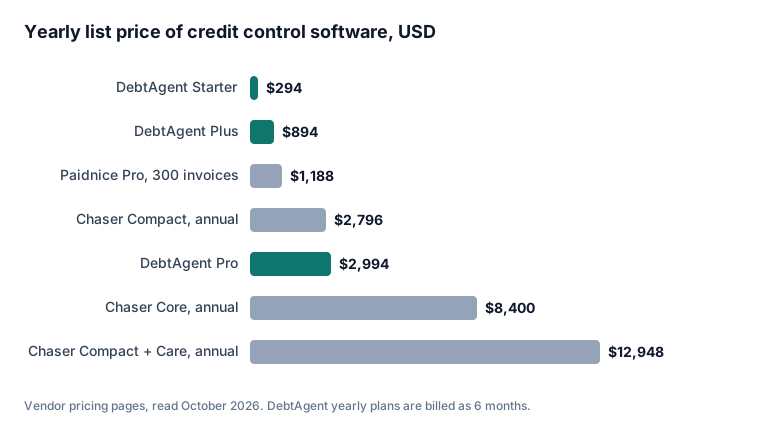
The yearly numbers are where the gap shows. Chaser Compact billed annually is $2,796 a year, and adding its Care credit control service through the Compact plus Care bundle takes that to $12,948. Kolleno's entry plan for one user billed annually is $6,540 a year before integrations. DebtAgent Starter billed yearly is $294, and Plus is $894 for 250 active debtors and up to 5 team seats. We keep the full side by side in our debt collection software pricing comparison, which covers 17 tools.
Is credit control software worth it for a small business?
Yes, once more than a handful of invoices a month go past due. The test is simple: if someone on your team spends two or more hours a week sending reminders and checking who paid, a $49 to $149 tool pays for itself in saved time before it collects a single extra dollar. The bigger return is speed, because invoices chased in the first 30 days are far more likely to be paid than ones left until day 90.
Where it is not worth it is the business with three or four customers who all pay on time. A calendar reminder does that job. And for a single large invoice that is already months late, with a customer who has stopped answering, software is the wrong tool. That file belongs with a contingency collection agency or an attorney.
Which credit control software works with QuickBooks or Xero?
Chaser, Paidnice and InvoiceSherpa all connect directly to QuickBooks Online and Xero and read open invoices from the ledger. Kolleno lists accounting and ERP integrations, and its pricing page warns that integrations can add to the bill. DebtAgent takes a CSV export of your aging report from either system, which most finance teams can produce in under a minute, so there is no connection to approve or maintain.
If your team lives in QuickBooks, our page on QuickBooks accounts receivable automation covers the built-in reminder limits (three reminders, email only, invoices sent from QuickBooks only) and what to add on top. Xero users can start from Xero accounts receivable automation.
Credit control software vs a collection agency
Software keeps you as the person asking for the money, and an agency replaces you. That is the whole difference, and it decides which one to use. Software suits invoices under about 90 days late where the customer is still reachable, because a steady, polite sequence in your name gets most of them paid without hurting the relationship. An agency suits files where your own contact has failed.
Agencies also cost a share of what they recover. US commercial contingency commonly runs 20% to 35%, and toward 50% on small or old balances. Many agencies decline claims under $2,500 to $5,000 altogether. A tool that clears the easy invoices first means you only pay a percentage on the ones that genuinely need it.
Is Chaser or Kolleno available in the US?
Chaser sells to US companies and shows USD pricing, though its revenue bands are still set in pounds (under £4 million, £10 million and £100 million). Kolleno prices per user (the same figure in pounds, euros or dollars depending on where you view it) and is built around UK and European finance teams with turnover over $1 million. Both are capable platforms. For a US small or mid-size business they are often more product, and more cost, than the problem needs.
We compare each in detail in our Chaser alternative page and our Kolleno pricing breakdown. If you are weighing the two volume-priced tools instead, the Paidnice vs InvoiceSherpa pricing comparison works out the yearly cost at three invoice volumes.
What DebtAgent does not do
Being straight about this saves you a trial. DebtAgent does not run credit checks or set credit limits for new customers, does not take card payments or run autopay, and does not chase invoices before they are due. It does not file suit, obtain judgments or act as a licensed collection agency. If you need a credit decisioning tool or a full receivables suite with a payment portal, Chaser, Paidnice or Upflow will suit you better.
What it does is the part of credit control that eats the most hours: chasing overdue invoices, consistently, in your name, at a price a five person company can approve without a meeting. Plans and limits are on the pricing page.
Credit control software questions
What is credit control software?
Credit control software automates the process of getting customers to pay invoices on time. It sends scheduled reminders, escalates the tone as invoices age, logs promises to pay and disputes, and stops chasing when an invoice is paid. In the US the same category is usually called collections software or accounts receivable automation.
How much does credit control software cost?
From about $40 to over $2,500 a month. Payt starts at €39.95 and Paidnice at $69 a month by invoice volume, Chaser at $259 a month for 4 users, and Kolleno at $650 per user per month. DebtAgent is a flat $49, $149 or $499 a month, with yearly billing at the price of 6 months.
What is the best credit control software for a small business?
For a US small business chasing fewer than a few hundred overdue invoices, a flat or volume-priced tool is usually the better buy than a per-seat platform. DebtAgent at $49 a month and Paidnice at $69 a month are the cheapest entry points priced in dollars. Chaser suits larger teams that want its managed Care service.
Can credit control be automated?
Most of it can. Reminder scheduling, tone escalation, stopping on payment, logging promises and keeping a dated record are all routine and well suited to software. Decisions still need a person: whether to grant credit, whether to accept a payment plan, and when to pass an account to an agency or attorney.
Does DebtAgent charge a percentage of what it collects?
No. DebtAgent is a flat monthly subscription and your customers pay you directly, so there is no commission and no fee on any invoice they settle. That is the main difference from a collection agency, which typically keeps 20% to 35% of what it recovers on US commercial claims.
Is there a credit control software that sends texts as well as emails?
Yes. Paidnice charges $0.10 per SMS, InvoiceSherpa includes SMS on every plan, and DebtAgent adds SMS steps to the email sequence on its Plus plan at $149 a month and above.
You are handing us your customers' names. Here is what happens to them.
Collections data is unusually sensitive, so we treat it that way: TLS in transit, encrypted storage, a full compliance audit log, and debtor records that are never used to train public models. Card details go to our payment processor and never touch us. Account deletion means delete, everywhere. We are also honest about where we are not yet: no SOC 2 report yet, no SSO yet, no invented customer logos or testimonials either.
Put your overdue invoices on a schedule today
Load one real past due invoice and the agent drafts the full friendly, firm and final sequence in your name. Approve it once and it sends on schedule, with no per-seat fee and no share of what you recover.
-
Compare Chaser alternative and Chaser pricing Chaser's real USD plans and Care bundles against a $49 flat fee.
-
Pricing Kolleno pricing per user, worked out What BusinessPay and Business Plus cost a year for a US team.
-
Compare Paidnice alternative for overdue invoices Paidnice's volume tiers and when a flat plan is cheaper.
-
Reminders Payment reminder software for B2B invoices Automated reminders before and after the due date.
-
Pricing Debt collection software pricing, 17 tools Every published price we could verify, in one table.
-
debt collection compliance software Debt Collection Compliance Software With FDCPA, Regulation F and TCPA Guardrails for US Creditors
-
accounts receivable collections software Accounts Receivable Collections Software and Receivables Management Tools for US Finance Teams
-
Atradius Collections Atradius Collections Fees, Commission Rates and a Flat Fee Alternative for US Invoices
-
accounts receivable automation Accounts receivable automation software that works every invoice on a flat fee
-
credit and collections software Collections software for credit managers and what to check before you buy
-
best commercial debt collection agencies Commercial debt collection agencies and services for US businesses compared by fees and minimums