Billtrust Alternative for Small Business With Published Prices
Billtrust is quote only and built for suppliers billing hundreds of millions a year. Here are the priced alternatives a small business can buy this month, and when Billtrust is still the better choice.
Draft a compliant collection sequence for a real overdue amount. No card, no signup to preview.
The best Billtrust alternative for a small business is software with a published price that does the one job you actually need, which is usually getting overdue invoices paid. Billtrust publishes no price and sells a full credit-to-cash platform to suppliers that, on its own figures, average hundreds of millions in yearly billings. For a US company with one person on receivables, DebtAgent chases overdue invoices for $49 to $499 a month, and BILL, Paidnice, InvoiceSherpa and Chaser cover invoicing and reminders from $41 to $259 a month. Every competitor price below was read on the vendor's own pricing page in October 2026. DebtAgent is our product, so we also say where Billtrust is the better buy.
Why small businesses look for a Billtrust alternative
Billtrust is a serious product. Its site describes five modules (invoicing, payments, credit, collections and cash application), more than 200 connectors to ERPs and banks, and more than 260 AP portal integrations. It reports over 2,600 supplier customers invoicing more than $1 trillion a year between them. Divide one by the other and the average Billtrust customer bills well over $380 million a year.
That is the reason small businesses end up searching for something else. There is no pricing page, only a demo request, and getting value from the platform means connecting it to your ERP and your payment processing. A distributor with 40 customers and $8 million in sales does not need most of that. It needs invoices sent, overdue ones chased, and payments recorded, at a price it can approve this month without a procurement process.
Billtrust alternatives for small business compared on published price
| Tool | Published price | Best at | Watch for |
|---|---|---|---|
| DebtAgent | $49, $149, $499 or $898 a month; yearly costs half ($294, $894, $2,994, $5,388) | Escalating follow up on overdue invoices in your name, from a CSV or, on Pro, a QuickBooks Online or Xero sync | Does not issue invoices or process card payments; no AP portal uploads |
| BILL | AP and AR plans $49, $65 or $89 per user a month; card payments 2.9% | Invoicing and receiving payments alongside bill pay in one account | Per user pricing climbs with the team; reminders are basic |
| Paidnice | Essentials $69 a month for 150 invoices; Pro $99 to $799 by volume | Reminders, late fees and a payment portal on QuickBooks Online, Xero or Stripe | Price rises with invoices per month; SMS $0.10 each |
| InvoiceSherpa | $49, $99 or $199 a month ($41, $83, $166 yearly) | Simple reminder schedules for QuickBooks Online and Xero | Plus 1% of invoices paid through it, waived only through Propelr |
| Chaser | Compact $259 a month ($233 yearly) with 4 users; Core $779; Complete $1,169 | Mid-market reminder workflows, optional done-for-you credit control | Done-for-you Care is sold only in bundles from $1,199 a month |
| Versapay | No published price | Collaborative AR portal and cash application for midsize suppliers | Sales-led, quoted per year like Billtrust |
| Billtrust | No published price; demo request only | Invoicing, payments, credit, collections and cash application in one platform with AP portal uploads | Built and priced for large suppliers |
What is the best Billtrust alternative for a small business?
For most US small businesses the best Billtrust alternative is the reminders already in QuickBooks or Xero plus one focused tool for the invoices those reminders do not move. If late payment is the main problem, a collections tool such as DebtAgent at $49 to $149 a month does the most. If invoicing and getting paid by ACH is the problem, BILL fits better.
The useful question is which part of Billtrust you were hoping to buy. Small businesses usually want one of three things. The first is getting overdue invoices paid without someone spending Friday afternoon writing reminders. The second is a way for customers to pay online by card or ACH. The third is less manual work matching payments to invoices. No single cheap tool does all three as well as Billtrust does, but two inexpensive tools together usually cover them for under $3,000 a year.
If your problem is overdue invoices
Choose dedicated collections software. DebtAgent takes your open invoices from a CSV export, or on the Pro plan reads them from QuickBooks Online or Xero every morning, starts an escalating sequence when an invoice crosses the threshold you set, and stops when the invoice is paid. Each message is drafted for your approval and goes out in your company's name, moving from a friendly note to a firm notice and a final notice over about 45 days. Plans are counted by active debtors, so a business with 50 or fewer overdue accounts at a time pays $49 a month or $294 for a year. Our accounts receivable automation page shows how the sync and the cadence work together.
If your problem is getting paid online
Choose an invoicing and payments tool. BILL lets you send invoices and receive ACH and card payments from the same account you use to pay vendors, at $49 to $89 per user a month. Paidnice adds a payment portal and late fees on top of QuickBooks Online, Xero or Stripe from $69 a month. Your accounting software's own payment links may be enough on their own if volume is low.
If your problem is matching payments
Cash application is where Billtrust earns its price, and small tools are weakest. For a few hundred payments a month most small businesses manage with bank feeds in their accounting software and a clear remittance process. Asking customers to email remittance advice to one address helps, and if those emails pile up you can parse remittance advice emails into structured data before matching them to open invoices.
How much does Billtrust cost compared with these tools?
Billtrust does not publish what it costs. Its site offers a demo and a conversation with an expert, and buyer-data marketplaces we checked list no Billtrust contract values. Expect a yearly contract quoted by module and by payment volume, plus implementation work to connect your ERP. Ask for the yearly subscription, implementation fees and payment processing rates in writing before comparing.
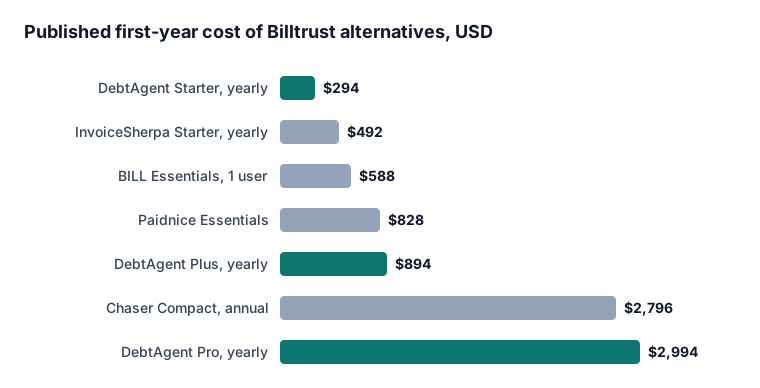
The published alternatives are easy to total. DebtAgent Starter is $294 a year billed yearly, Plus is $894 and Pro is $2,994. InvoiceSherpa runs $492 to $1,992 a year plus 1% of invoices paid through it. Paidnice Essentials is $828 a year. BILL's entry plan is $49 per user a month, or $588 a year for one user. Chaser Compact is $2,796 a year billed annually. Any of these combinations costs less in a year than many enterprise platforms charge for implementation, though we cannot quote Billtrust's own figure because it does not publish one.
For the full market, our debt collection software pricing comparison lists 17 tools with their published prices, and the best accounts receivable software for small business ranks the wider set by job.
Is Billtrust worth it for a small business?
Billtrust is worth it for a small business only when that business behaves like a large supplier: thousands of invoices a month, large customers who require invoices uploaded to their AP portals, card payments at volume, and a finance team spending real hours on cash application. For a company with a few hundred open invoices and one person on receivables, it is usually more platform than the problem needs.
We would point a buyer to Billtrust, not to us, in three situations. First, when big customers insist on invoices submitted through Coupa, Ariba or similar AP portals, because Billtrust lists more than 260 of those integrations and small tools have none. Second, when you process enough card payments that surcharging and payment acceptance terms matter to margin. Third, when cash application across multiple bank accounts takes a person most of the week. If none of those applies, start with a priced tool and revisit Billtrust when you outgrow it.
Which Billtrust competitors suit a growing midsize company?
A midsize company that has outgrown small tools but does not want a Billtrust-sized project usually looks at Versapay, Upflow, Gaviti or Tesorio. None of them publishes a dollar price, and all of them sell on a yearly contract. Upflow sets plans by yearly invoiced revenue, with the smallest plan covering up to $10 million, and Tesorio contracts reported on Vendr center on about $17,644 a year.
If you are comparing those, read our Upflow alternative and Gaviti alternative pages first. They show the published price of everything around those platforms, and where the platforms are the better buy.
How to switch from Billtrust, or avoid needing it
If you are leaving Billtrust or deciding not to buy it, keep the move small. Export open receivables to CSV and put only the overdue accounts into a collections tool for the first month. Leave invoicing and payment acceptance where they are until you have seen whether chasing alone fixes the cash problem. In most small businesses it fixes most of it, because the money that is late is a few dozen invoices that nobody followed up after the second reminder.
Run that test for 30 days on a monthly plan. If days sales outstanding falls and the 31 to 90 day bucket shrinks, you have your answer without a platform contract. If you find you also need AP portal uploads and cash application at scale, you will know exactly what to ask Billtrust for, and how much the chasing part is worth to you on its own.
Frequently asked questions
What is the best Billtrust alternative for small business?
For most US small businesses, the best Billtrust alternative is accounting software reminders plus one focused tool. DebtAgent chases overdue invoices from $49 a month, BILL handles invoicing and payments from $49 per user, and Paidnice adds reminders and a payment portal from $69. All publish prices; Billtrust does not.
How much does Billtrust cost?
Billtrust does not publish pricing. Its website offers only a demo request, and contracts are quoted by module and payment volume, usually as a yearly subscription with implementation work. Ask for subscription, implementation and processing fees in writing before you compare it with tools that list a price.
Is Billtrust mostly used by small businesses?
No. Billtrust reports more than 2,600 supplier customers invoicing over $1 trillion a year between them, which averages above $380 million per supplier. It is built for midsize and large B2B suppliers such as distributors and manufacturers, not for companies with one person on receivables.
Who are Billtrust's main competitors?
Billtrust's enterprise competitors include Versapay, HighRadius, Upflow, Tesorio, Gaviti, Esker and Quadient AR, none of which publish prices. For smaller businesses, priced alternatives include DebtAgent, BILL, Paidnice, InvoiceSherpa and Chaser.
Can I use DebtAgent with QuickBooks or Xero instead of Billtrust?
Yes. On every plan you can load open invoices from a QuickBooks or Xero CSV export, and on Pro DebtAgent connects to QuickBooks Online or Xero directly, reads open invoices every morning and starts an escalating sequence on overdue ones. It stops when the invoice is paid and never writes back to your ledger. It does not issue invoices or process payments, so it sits beside your accounting software.
- More on best accounts receivable software for small business: Seven accounts receivable tools a small business can buy without a sales call, with the published price of each, what that price is tied to, and the point where built-in QuickBooks reminders stop being enough.
- More on best collection agency for small business: Seven collection agencies that publish their rates, compared on fee, minimum claim and what they cost on $1,500, $3,000 and $10,000 invoices, plus when to chase first.
- Related page: Debt collection software
- Related page: Collection Agency for Small Business