Minimum Amount to Send to Collections and the Collection Agency Minimum Amount at 7 Agencies
No law sets a minimum amount to send to collections, but agencies do, from nothing at all to a $5,000 average claim. Seven agencies' stated floors, what a $1,200 invoice nets at each, and what to do with the invoices they turn away.
Draft a compliant collection sequence for a real overdue amount. No card, no signup to preview.
There is no legal minimum amount to send to collections. A US business can place a $40 invoice with an agency as lawfully as a $40,000 one. The real floor is each agency's own policy, and it varies widely. STA International takes commercial claims of $2,500 and above, Kaplan Group's rate card starts at $3,000 and its FAQ asks new clients for an average claim over $5,000, while Summit A•R states no minimum at all and flat-fee services like Rocket Receivables charge $14.95 to $21.95 per account regardless of size.
So the useful question is not whether an invoice is big enough to send, but which kind of collector will take it and what you keep afterwards. Below are the stated minimums of seven agencies, read on their own websites in September and October 2026, then the net you would keep on a $1,200 invoice at each, and what to do with the invoices every agency turns away.
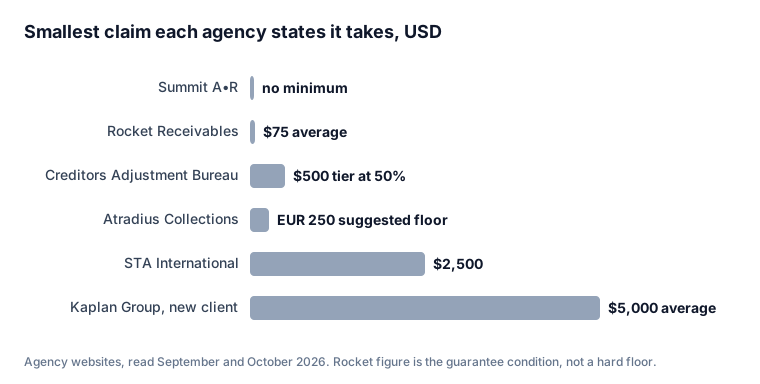
Collection agency minimum amount at 7 US agencies
| Agency | Stated minimum | What it charges |
|---|---|---|
| STA International | Commercial claims of $2,500 and above | 25% on the first $5,000 collected, 20% on the balance; 30% to 33% international |
| Kaplan Group | Rate card starts at $3,000; new clients need an average claim over $5,000, established clients from $1,000 | 25% from $3,000 to $9,999, falling to 10% at $500,000; 30% if the debtor is outside the US |
| Atradius Collections | No hard minimum; its FAQ calls claims below EUR 250 not cost effective | US debtor 23% up to $2,500, 18.5% above; $55 plus 25.5% for most other regions |
| Creditors Adjustment Bureau | No floor, but small balances carry its top rate | 50% of the first $500, 20% of the balance; 50% once the debt is over a year old |
| Summit A•R | States no quotas or minimums | Contingency from 7.5% to 50% |
| Rocket Receivables | No floor; its guarantee needs an average principal of $75 or more and accounts under 6 months from last payment | Flat $21.95 per account at 10, $17.95 at 25, $14.95 at 50; Stage One accounts expire 12 months after purchase |
| Coast To Coast Financial Solutions | No floor published | Flat fee, less than $10 per account on average |
Two patterns stand out. The commercial contingency agencies that work B2B claims with litigation behind them set a floor between $2,500 and $5,000, because a file needs collector time, skip tracing and sometimes a forwarding attorney, and a percentage of a small balance does not cover it. The agencies that take any size either price small balances at 50% or switch to a flat fee per account, which buys letters and sometimes calls rather than a collector working the file. Our detailed pages on STA International collection rates, Kaplan Group's rate card and Creditors Adjustment Bureau fees walk through each card line by line.
What is the minimum claim size a debt collection agency will take on?
For US commercial (B2B) collection agencies the typical minimum is $2,500 to $5,000 per claim, or an average across the claims you place. STA International states $2,500, and Kaplan Group asks new clients for an average claim over $5,000. Agencies that handle consumer or small-balance work often have no minimum, but charge up to 50% or a flat fee per account instead.
Minimums are often softer than they look. Kaplan accepts claims from $1,000 for established clients, and several agencies will take small files if you place a batch alongside larger ones. If you have one $800 invoice and nothing else, expect to be declined or quoted the top rate. If you have twenty small invoices, ask whether they will take them as a portfolio.
Is there a minimum amount to send to collections?
No law sets one. No federal or state statute stops a business from referring a debt of any size to a collector, and pure business-to-business debts sit outside the Fair Debt Collection Practices Act entirely, because that law covers debts incurred for personal, family or household purposes. The practical minimum is economic: the fee, your staff time and the customer relationship have to be worth less than the money you expect back.
What you keep on a $1,200 invoice at each agency
The fairest way to compare these structures is one realistic small invoice. Here is a $1,200 B2B invoice, 75 days past due, with a customer in the US who is slow rather than insolvent, assuming the full amount is recovered.
| Route | Fee if collected in full | You keep |
|---|---|---|
| STA International | Below the $2,500 minimum | Declined |
| Kaplan Group, new client | Below the $3,000 card and the $5,000 average | Likely declined |
| Atradius Collections, US debtor | 23%, $276 | $924 |
| Creditors Adjustment Bureau | 50% of $500 plus 20% of $700, $390 | $810 |
| Summit A•R | 7.5% to 50%, $90 to $600 | $600 to $1,110 |
| Rocket Receivables Stage One | $14.95 to $21.95, paid up front | $1,178 to $1,185 if the letters work |
| DebtAgent Starter | $49 for the month, covering up to 50 debtors | $1,151, or more per invoice if you chase several |
Two cautions keep this table honest. First, contingency is only paid if money comes in, while flat fees are paid whether or not the customer pays. Second, the flat-fee services buy a short letter series, not a collector who negotiates. If that series fails, Rocket's Stage Two moves to a 50/50 split. The table shows the best case for each route, not a prediction.
Also read the placement agreement for the direct payment clause. Most agencies still earn their percentage when the customer pays you directly after the account is placed, which surprises a lot of first-time clients. When that payment lands, matching the deposit to the right invoice is quicker with bank reconciliation software than with a spreadsheet, and it gives you a clean record if the agency's statement disagrees with yours.
Is it worth sending a small invoice to collections?
Usually not as the first step. On invoices under about $2,500, a firm, well-timed sequence from you recovers most of what an agency would, keeps the customer, and costs a flat fee instead of a quarter to a half of the balance. Collections makes sense for a small invoice once your own written demand has been ignored and the customer has stopped responding.
Age matters more than size. US recovery rates commonly run above 70% for invoices under 90 days past due and fall below 15% for balances past 180 days. A $900 invoice chased steadily at day 20 is a better asset than a $3,000 invoice nobody has touched since spring. That is why the cheapest collections strategy for small balances is to start earlier, not to find a cheaper agency later.
What can I do if my invoice is below the agency minimum?
You have four realistic options, and they work best in this order.
- Run a structured sequence yourself. A friendly reminder, a firm follow-up, a final notice with a date, and a clear statement of the next step. Most small B2B invoices are paid somewhere in that sequence. Software sends it on schedule so it does not depend on someone remembering.
- Send a formal demand letter. A written demand that states the amount, the invoice and the deadline is cheap and often enough on its own. It is also the document every court and agency will ask for later.
- Use a flat-fee agency service. Rocket Receivables or Coast To Coast charge a few dollars to about $22 per account for third-party letters, which can move a customer who ignores you. Our flat fee debt collection page compares the published prices.
- File in small claims court. Filing fees commonly run $30 to $100, and limits vary by state, from a few thousand dollars up to $25,000. In California a business can claim under $6,250, half the individual limit. Our guide to small claims court for unpaid invoices covers when suing pays and what to do after you win.
For businesses holding a stack of small invoices rather than one, our small claims debt collection page sets out how to make B2B balances under $3,000 worth recovering without a retainer.
A flat-fee way to chase the invoices agencies turn away
DebtAgent was built for exactly the invoices on the wrong side of an agency minimum. You upload the overdue invoices as a CSV export from QuickBooks, Xero or any system that prints an aging report, or type them in. The agent drafts an escalating sequence in your company's name: a friendly reminder, a firm follow-up, a final notice and the last step you choose. You approve the wording once, it sends on schedule, logs every promise to pay and stops for a debtor the moment you mark the invoice paid.
Customers pay you directly, so there is no commission and no direct payment clause to worry about. Starter is $49 a month for 50 active debtors, Plus is $149 for 250 with SMS steps added, and Pro is $499 for 1,000 sequences a month, with yearly billing at the price of six months. All plans are on the pricing page, and if you are comparing it against other tools, the credit control software price table lists the alternatives in dollars.
Be clear on the limits too. DebtAgent is not a licensed collection agency, does not file suit and does not obtain judgments. When a file needs that, place it with a contingency collection agency, ideally after the sequence has already cleared the easy ones.
Frequently asked questions
What is the minimum claim size a debt collection agency will take on?
US commercial collection agencies typically set a minimum of $2,500 to $5,000 per claim or as an average. STA International states $2,500 and Kaplan Group asks new clients for an average claim over $5,000. Small-balance agencies often have no minimum but charge up to 50% or a flat fee per account.
Is there a minimum amount to send to collections?
No. No federal or state law sets a minimum amount a business can send to collections. Each agency sets its own floor, and the practical minimum is where the fee and your time stop being worth the amount you expect to recover.
Can I send a business customer to collections for $500?
Yes, legally, but most commercial agencies will decline it. Agencies that accept it, such as Creditors Adjustment Bureau, charge 50% of the first $500, and flat-fee services charge about $15 to $22 per account for a letter series. A firm sequence from you is usually cheaper and just as effective at that size.
Is it worth sending a small invoice to collections?
Rarely as a first step. Under about $2,500, your own written sequence and a formal demand recover most invoices without a 25% to 50% fee. Collections is worth it once your demand has been ignored and the customer has stopped responding.
How much does it cost to send an invoice to collections?
Contingency agencies keep 20% to 35% of what they recover on US commercial claims, rising toward 50% on small or old balances, and nothing if they collect nothing. Flat-fee services charge roughly $10 to $22 per account up front. Most agencies still take their fee if the customer later pays you directly.
- More on best collection agency for small business: Seven collection agencies that publish their rates, compared on fee, minimum claim and what they cost on $1,500, $3,000 and $10,000 invoices, plus when to chase first.
- More on can you send an unpaid invoice to collections: You can send any past-due invoice to collections whenever you choose. What matters is the timing, the paperwork, and whether an in-house reminder would have worked first.
- Related page: International Debt Collection
- Related page: Law Firm Collections